Introduction
The concept of developing variation was first proposed and discussed by the composer/theorist, Arnold Schoenberg. In his discussions of developing variation, Schönberg describes how a small musical idea with distinct melodic and rhythmic features, a motive, can develop into something new through variation to some of its basic features. Various forms of the basic motive can then combine in order to generate larger musical units. Developing variations was used by Schönberg to analyze the music of Brahms, whose compositions represented the most advanced form of developing variations.
|
Motive
In music, a motive is a short musical idea, a salient recurring figure, musical fragment or succession of notes that has some special importance in a composition. The motive may have harmonic, melodic and/or rhythmic aspects.
Repetition and monotony
In his 'Fundamentals of composition' Schönberg says something about the 'special importance' of the motive. He states that "even the wrting of simple phrases involves the invention and use of motives...". The motive should result in "unity, relationship, coherence, logic, comprehensibility and fluency". This is possibles because in a piece, because a motive is repeated. However, repetition alone results in monotony, which can be overcome by variation.
Variation
Because variation means change and change can result in incoherency, the basic question in motive variation is: what to change and what to preserve. The answer depends on the compositional objective.
Developing variation
As already said, various forms of the basic motive can then combine in order to generate larger musical units, which is in fact 'growth'. This is the key of 'developing variation': variation and development, change and growth. As noted, this process of constant modification of motives and ideas, in other words modified repetitions, is thought to be superior to exact repetitions.
Subordinate changes, i.e. "changes with subordinate meaning", changes as mere embellishment, can be -according to Schönberg better termed as 'variants'.
Developing variation is a technique to be found in homophonic music, where it takes place by means of a variation in a single voice.
Examples of developing variation
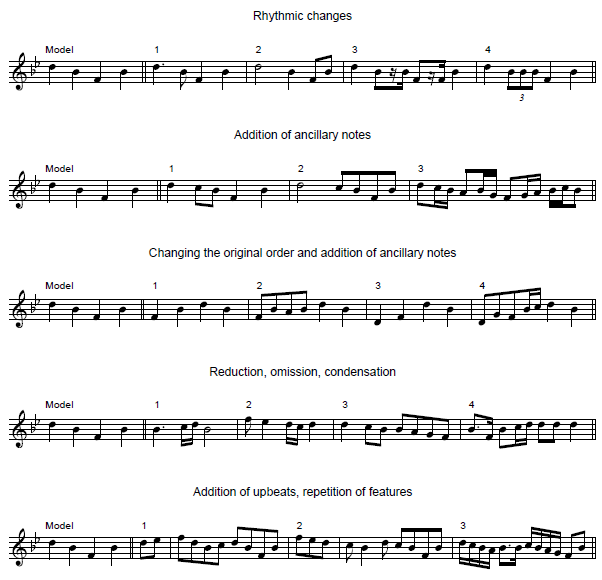
In his 'Fundamentals of composition' Schönberg shows modified repetitions on a simple broken chord. He gives some examples of changing the harmonic context of a melodic motive, but our concern here are his examples of rhythmic and intervallic modifications. A few of them will suffice.
|
|
|